
Platform review
Trueo review
Prediction markets on Base where open positions earn yield; closed to the US and Canada
In United States: Contracts and services are not offered to US Persons. Terms of Use (no date shown).
Our verdict
The best-documented of the newer venues, with a feature none of the others has: open positions accrue yield while you hold them. Trueo settles on Base, its markets carried real prices with meaningful liquidity when we read them, and its terms actually name the operator — Walking Wisdom International CO., Ltd., incorporated in Samoa — alongside a full restricted- territories list that excludes US persons and Canada without exception.
The board is narrower than the leaders: crypto, politics, technology, business and finance, with no sports. No licence, no regulator, and Samoa incorporation carries no consumer protection a reader could invoke, which is the ceiling on any assessment of it. Fees, minimum deposit and withdrawal terms are not published anywhere we could find.
Best for a non-US, non-Canadian trader who wants economic and political questions and values earning on idle collateral.
Risk flags
- HighNo licence stated. The operator’s documents name no regulator or licence, so disputes and frozen funds are settled by its own process. Every platform’s licence →
- WatchFees not published. We could not find a fee schedule in the operator’s documents; an unstated fee is not a zero fee. Fees compared →
- NoteNot open to US residents. The operator excludes US residents in its terms. Platforms open in the US →
Flags are rules over the facts on record, the same for every platform — how they work.
Verified documents & product scope
Check country eligibility
Choose the country you want to check. This lookup does not change your site region or establish individual account approval.
What fees does Trueo charge?
Trueo trades YES/NO tokens in Uniswap pools and describes returns as “net of fees”, but publishes no trading-fee rate. The one published rate is for markets funded by proposal: “A 5% launch fee is charged only if the proposal successfully graduates.” Creators “earn creator fees”, at no stated rate; minting and redeeming (1 YES + 1 NO for 1 TYD) carry no stated fee (docs.trueo.com, read 2 Oct 2026).
These are document checks, not a funded-account test. Access may depend on residence, physical location, account approval and the contract category. Check the operator’s current terms before depositing.
Learn how play-money and real-money markets differ, use the fee and payout tools, or read our review methodology.
See our Platform documentation audit for the method and downloadable source register.
- Trueo Terms of Use — checked
The terms identify a Samoan operator and expressly exclude US persons and a list of other territories. They prohibit using a VPN to bypass restrictions.
- Trueo docs — trading — checked
Example returns are “net of fees”; no trading-fee rate is given.
- Trueo docs — proposal funding — checked
“A 5% launch fee is charged only if the proposal successfully graduates”; none if it fails.
Pros and cons
What works
- A permissionless optimistic oracle: anyone may propose an outcome by posting a bond, opening a 12-hour challenge window
- Four named escalation stages ending with 11 randomly selected attesters
- Constrains its own privileged body — all Oracle Council decisions may be permissionlessly challenged
- No admin override, emergency power or discretion clause attaches to market outcomes anywhere in the documentation
- Names its operator and publishes a full restricted-territories list with “We do not make exceptions”
What doesn’t
- None of the design is evidenced in operation: there is no public dispute record
- The final escalation is gated at 250,000 liquid TRUE, putting the last word with large holders
- Market creation is still restricted to Oracle Council members in the genesis phase
- The sources a dispute is judged against are not fixed — alternatives may be used
- No licence or regulator; Samoa incorporation carries no consumer protection a reader could invoke
Public website & interface
Dated website captures for identification and interface context. Displayed prices are historical; these images do not establish account eligibility or a funded-account test.
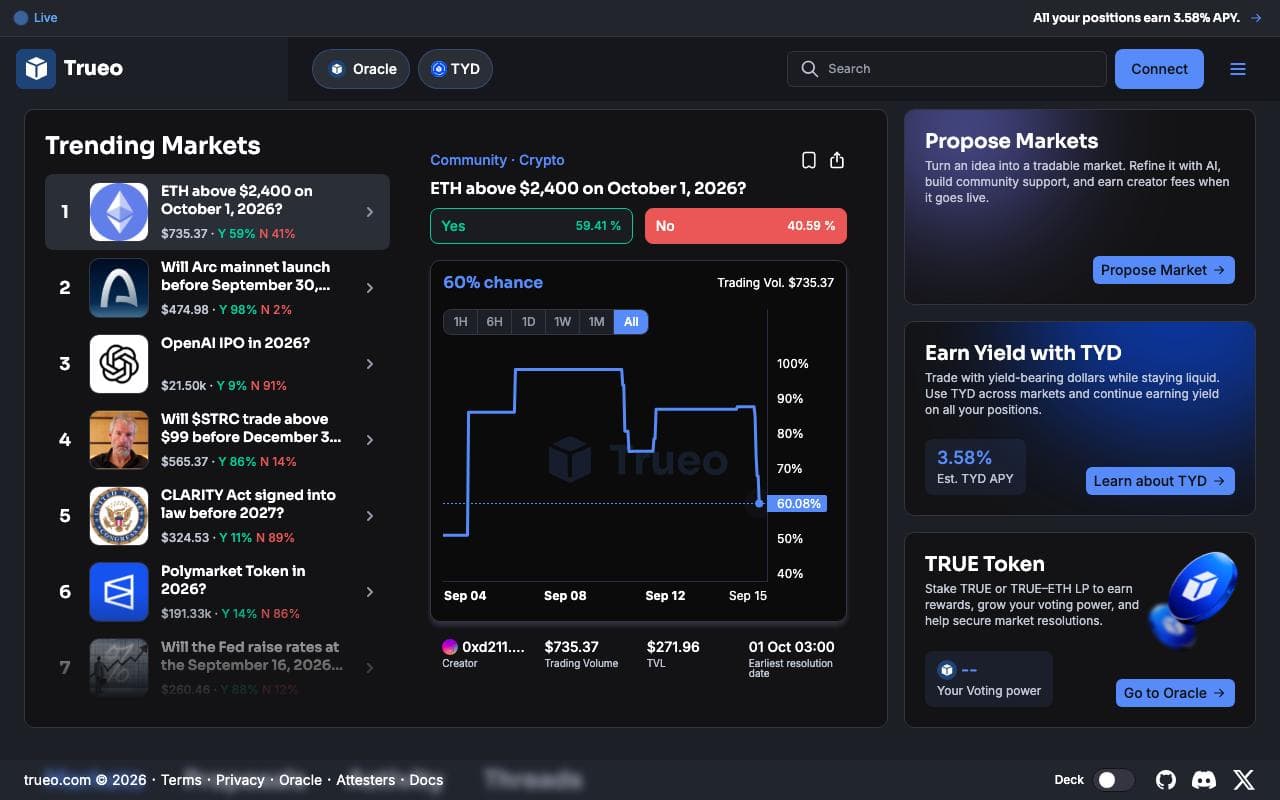
Trueo public website, captured 16 September 2026 · Source website · View full image
Prices and liquidity
We do not currently publish live quotes for Trueo. Check the platform’s order book before placing an order: the last trade can differ from the price available for your position size.
How to assess liquidity and spreads →The most elaborate resolution design we have read
Trueo publishes a permissionless optimistic oracle, and the detail is unusual. “Any participant may permissionlessly propose a resolution by posting a bond behind their chosen outcome. This action initiates a 12-hour challenge window”, and “The resolver role is fully permissionless” — so proposing an outcome is not a privilege the venue grants.
Disputes escalate through four named stages: Initial Challenge, Oracle Council Arbitration, TRUE Holder Escalation and Vote, and Attester Final Verdict, which ends where “11 attesters are randomly selected from the attester pool”. Random selection at the final stage is a deliberate defence against capture of the last word by a known set of parties.
More unusually still, the venue constrains its own privileged body rather than exempting it: “While the OC plays a critical role, its authority is intentionally constrained”, and “All Oracle Council decisions may be permissionlessly challenged”. We searched the documentation for admin, override, emergency, pause and discretion and found nothing attaching to market outcomes — the only such clauses in the terms attach to the service, not to a market. Almost no venue on this site can say that.
None of it is evidenced in operation
A published design is not a track record, and that is why this rates where it does rather than near the top. There is no public dispute record: nothing shows the mechanism being used, contested, or holding up under pressure.
Three details also constrain it in practice. The final escalation is gated at “at least 250,000 liquid TRUE”, which puts the last word with large holders whatever the randomness at the attester stage. Market creation is still “restricted to Oracle Council members” in the genesis phase, so the permissionless proposing sits on top of permissioned listing. And the sources a dispute is judged against are not fixed — “alternative sources may be used if the listed sources are unavailable, faulty, or superseded”.
None of those is damning on its own. Together they mean the elaborate machinery has not yet been tested by anything, and the parts that would decide a hard case are the parts still in the hands of a few.
Disclosure is the best of its cohort
Its terms name the operator — “Walking Wisdom International CO., Ltd., a corporation organized and existing under the laws of Samoa” — which is more than almost any venue in this group states. It also publishes a full restricted-territories list excluding US persons and Canada, with the flat sentence “We do not make exceptions”.
No licence and no regulator is named. Samoa incorporation carries no consumer protection a reader could invoke, which is exactly what holds the regulation rating below a pass mark: knowing who the operator is and where they are incorporated is useful, and it is not the same as having somewhere to complain.
The books are thin but real
Individual markets carried between $13,000 and $191,000 of liquidity with genuine two-sided prices when we read them on 8 September 2026. That is thin against the leaders and an order of magnitude better than the venues we score at the bottom of this list, where markets showed double-digit dollar figures or no prices at all.
This is an observation rather than a measurement — we have taken no spread or depth readings of our own, so it is not a full mark in either direction. What it does establish is that the venue is quoting real markets rather than displaying an empty book, which several of its peers were not.
Trueo FAQ
- How does a Trueo dispute escalate?
Through four named stages. Any participant may propose an outcome by posting a bond, which opens a 12-hour challenge window; a challenge goes to Oracle Council Arbitration; that can be escalated to a TRUE holder vote; and the final stage is an Attester Final Verdict where “11 attesters are randomly selected from the attester pool”.
Unusually, the venue constrains its own privileged body — “All Oracle Council decisions may be permissionlessly challenged” — and no admin override or emergency clause attaches to market outcomes anywhere in its documentation.
- If the design is that good, why is the rating not higher?
Because a published design is not a track record. There is no public dispute record showing the mechanism used or tested.
Three details also constrain it: the final escalation is gated at “at least 250,000 liquid TRUE”, which puts the last word with large holders; market creation is still “restricted to Oracle Council members” in the genesis phase, so permissionless proposing sits on top of permissioned listing; and the sources a dispute is judged against are not fixed, since “alternative sources may be used if the listed sources are unavailable, faulty, or superseded”.
- What fees does Trueo charge?
Trueo trades YES/NO tokens in Uniswap pools and describes returns as “net of fees”, but publishes no trading-fee rate. The one published rate is for markets funded by proposal: “A 5% launch fee is charged only if the proposal successfully graduates.” Creators “earn creator fees”, at no stated rate; minting and redeeming (1 YES + 1 NO for 1 TYD) carry no stated fee (docs.trueo.com, read 2 Oct 2026).
- Is Trueo regulated?
The best-documented of the venues added here. Its Terms of Use state the interface “is made available by Walking Wisdom International CO., Ltd., a corporation organized and existing under the laws of Samoa”. No licence and no regulator is named. Settlement is on Base — the app’s own status indicator reads “base: up”.
Its distinguishing feature is stated on the interface rather than in the Terms: “All your positions earn 4.03% APY”, so capital committed to a market accrues yield while the position is open. That rate is a live figure and is deliberately NOT recorded as a platform field, because it will be stale within days.
Products are “NOT OFFERED” to US Persons or to residents of Algeria, Bangladesh, Bolivia, Belarus, Burundi, Myanmar, Canada, Ivory Coast, Crimea and Sevastopol, Cuba, the Democratic Republic of Congo, Ecuador, Iran, Iraq, Liberia, Libya, Mali, Morocco, Nepal, North Korea, Somalia, Sudan, Syria, Taiwan, Venezuela, Yemen and Zimbabwe, with “We do not make exceptions” and a VPN prohibition.
Markets carried real two-sided prices and liquidity between $13k and $191k when read on 8 September 2026, which is why this record is fuller than its neighbours. UNVERIFIED: every fee, the minimum deposit, the deposit currency, withdrawal terms, and whether identity verification is required — the Terms do not mention KYC at all.
- What can you trade on Trueo?
Event contracts on crypto, politics, economics and other events. Individual markets open and close, so check the live list before depositing.
Alternatives to Trueo
Chosen by similarity — the same kind of venue, overlapping markets, and whether you can use it where you are — then by Editor Score.
- AvailableDelphiCrypto · on-chain3.5
- AvailableAlpha ArcadeCrypto · on-chain5.1
- AvailableRainCrypto · on-chain—
- RestrictedPolymarketCrypto · on-chain6.9
- Availability unverifiedSeerCrypto · on-chain3.9
- Availability unverifiedHedgehog MarketsCrypto · on-chain1.7