
Platform review
Manifold Markets review
Play-money forecasting community
In United States: Play-money mana trading is open to users 13+ (minors need a guardian). Outside the listed states, US residents aged 18+ can also enter prize drawings.
Our verdict
Play money, and that single fact should decide whether you open it. Mana cannot be converted to cash, so a price gap between here and a real-money venue is not an arbitrage and we never present it as one.
What it buys is the best place in the category to learn the instrument: identical mechanics, no consequence for being wrong, and by far the widest set of questions because anyone can create a market. The catch is the other side of that openness — resolution criteria are whatever the person asking typed into a description box, and they settle it themselves.
Note also that it is not purely play-money: its Prize Drawing pays in USDC and its Official Rules void entry in eight US jurisdictions. Best for learning, for forecasting practice and for questions no regulated exchange will list. Not a place to put money to work, because there is no way out.
Risk flags
- WatchLimited in 8 US states. Restricted in DC, DE, ID, MA, MI, NV, NY, WA — by the operator’s rule or a state order. What each state has done: District of Columbia, Delaware, Idaho, Massachusetts, Michigan, Nevada, New York, Washington. State-by-state availability →
- NoteScored on under half the criteria. The score rests on 39% of the criteria by weight; the rest are not yet rated. How scoring works →
- NotePlay money only. Balances are not cash and cannot be withdrawn as money.
Flags are rules over the facts on record, the same for every platform — how they work.
Verified documents & product scope
Check country eligibility
Choose the country you want to check. This lookup does not change your site region or establish individual account approval.
Where is Manifold Markets available?
Manifold’s play-money markets and its prize drawings have different eligibility rules. Mana is not a cash balance. Prize entry and awards depend on age, residency and verification requirements.
What fees does Manifold Markets charge?
Manifold trades in mana, its play-money currency, which “cannot be converted to cash”; every user starts with M1000 free and more mana can be bought (docs.manifold.markets/faq, read 2 Oct 2026). The FAQ mentions no per-trade fee. Creating a market costs mana, and “the entirety of the initial cost goes towards liquidity”; some market types cost more.
Free daily loans are interest-free; margin loans for Plus, Pro and Premium members “accrue 0.03% interest per day”.
These are document checks, not a funded-account test. Access may depend on residence, physical location, account approval and the contract category. Check the operator’s current terms before depositing.
Learn how play-money and real-money markets differ, use the fee and payout tools, or read our review methodology.
See our Platform documentation audit for the method and downloadable source register.
- Prize Drawing Official Rules — checked
Prize eligibility is separate from play-money markets. The rules name restricted countries, Ontario and eight US jurisdictions; identity checks may apply to prizes.
- Manifold FAQ — mana, market creation and loans — checked
Mana “cannot be converted to cash”; users start with M1000 and can buy more. No per-trade fee is mentioned. Market creation costs mana that funds liquidity. Margin loans accrue 0.03% interest per day.
Pros and cons
What works
- No money at risk — play currency only
- Anyone can create a market
- Open API and public leaderboard
- No KYC and no deposit needed
What doesn’t
- Prices are not backed by capital, so they forecast less reliably
- Market quality varies widely
- No cash withdrawal
- No mobile apps
Public website & interface
Dated website captures for identification and interface context. Displayed prices are historical; these images do not establish account eligibility or a funded-account test.
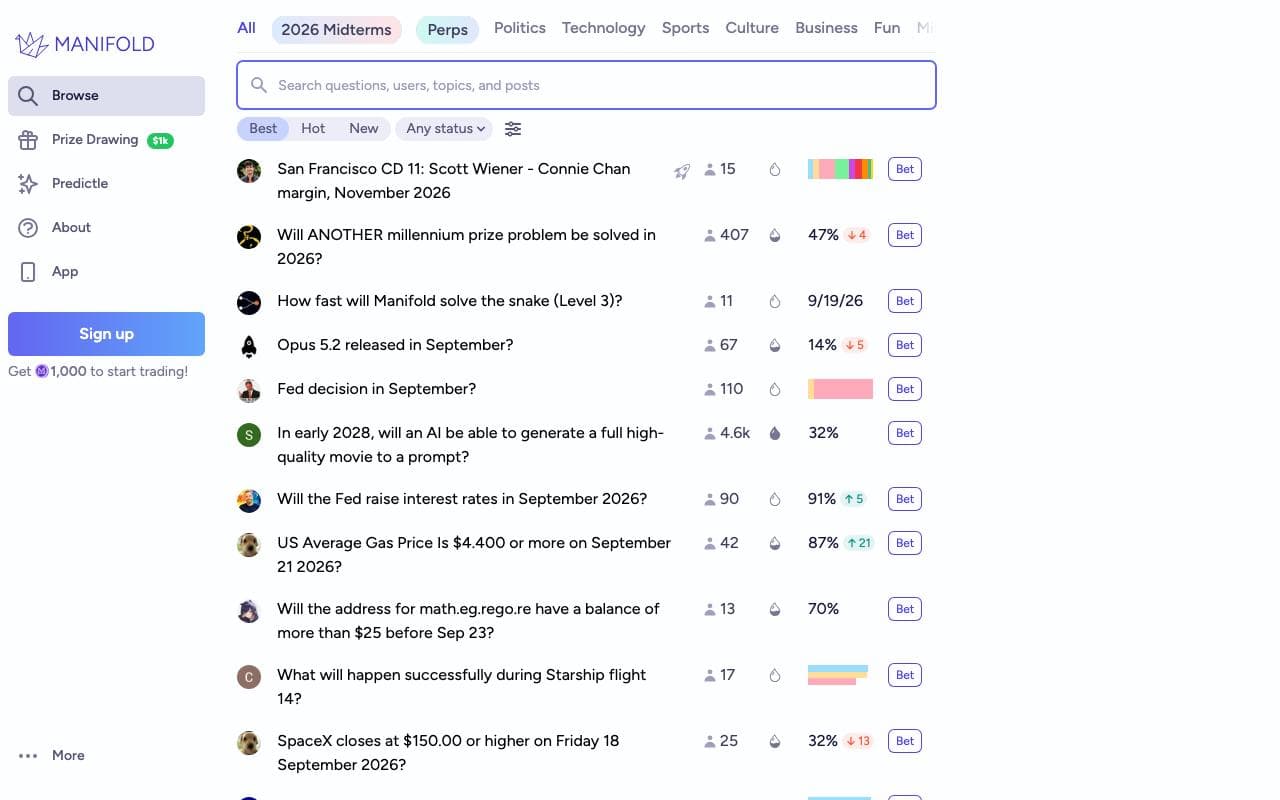
Manifold Markets public website, captured 16 September 2026 · Source website · View full image
Prices and liquidity
We do not currently publish live quotes for Manifold Markets. Check the platform’s order book before placing an order: the last trade can differ from the price available for your position size.
How to assess liquidity and spreads →How Manifold works
Manifold’s main markets are denominated in mana, which is play money. The site states plainly that mana “cannot be converted to cash” and that every user starts with M1000 for free. Signing in is a Google or Apple account and takes under a minute; verifying a phone number is an optional bonus quest rather than a requirement.
That single fact governs everything else on this page. A price difference between a Manifold market and a real-money venue is not an arbitrage, because no trade converts mana into dollars. Our comparison pages report such differences and never present them as an opportunity.
Pricing comes from an automated market maker rather than an order book, so a binary market publishes one probability and the NO side is its complement. The two sum to exactly one, which means the spread is zero — honest, but not the same as costless. The real cost is slippage: moving the price is what you pay, and it grows with the size of your position against the depth of the pool.
Manifold Markets fee structure
Manifold’s costs, as its own FAQ states them (docs.manifold.markets, read 2 October 2026):
Trading. Markets trade in mana, which “cannot be converted to cash”. Every account starts with M1000 for free, more mana can be bought, and the FAQ mentions no fee on an individual trade — though an unstated fee is not a verified zero.
Creating a market. Opening a market costs mana, and “the entirety of the initial cost goes towards liquidity”; some market types cost more because they need more liquidity to work.
Loans. Free daily loans against open positions are interest-free; margin loans, for Plus, Pro and Premium members, “accrue 0.03% interest per day”.
Because mana has no cash value, none of these is a cost in money. Money enters only if you choose to buy mana or a membership, and cash leaves only through the separate prize drawing described below. How that compares with real-money venues is set out in Kalshi vs Manifold and our fees guide.
What it is good for
It is the best place in this category to learn how the instrument behaves, precisely because being wrong costs nothing. The mechanics of buying a probability, watching it move against you and settling are identical to the real-money venues; only the consequence differs.
It is also the widest market set, because anyone can create a market. That is its strength and its weakness in the same breath: the questions cover far more ground than any regulated exchange lists, and the resolution criteria are whatever one user typed into a description box.
That last point is not a small caveat. On a regulated venue the settlement rules are drafted to be enforceable; here they are drafted by the person who asked the question, and they are resolved by that same person. It is why we fetch each Manifold market individually rather than from the list endpoint — the list omits the description, and a market whose criteria nobody has read cannot take part in a published comparison.
The part that is not play money
Manifold also runs a Prize Drawing, and prizes there are paid in USDC. Its Official Rules, last updated 3 February 2026, state that Prize Drawings are “VOID” in Delaware, Idaho, Massachusetts, Michigan, Nevada, New York, Washington and Washington, D.C., and that residents of those territories “are not eligible to enter or win”.
So the venue is not purely play-money, and the boundary matters when reading anything about it — including this page. Play-money trading itself is not restricted in those jurisdictions by any Manifold document we could read; it is the prize mechanism that is. Whether claiming a prize requires identity verification is not stated anywhere we found, which is why our KYC field for this venue is empty rather than set to “no”.
A quirk worth knowing
A Manifold market reports itself resolved only once its creator settles it, and on a venue where questions are settled by the people who asked them that can lag the close by weeks, or never happen. A market that stopped trading in February can still describe itself as open.
Our board therefore judges a market on its close time as well as its own flag, which is how two settled contracts stopped appearing as live. If you trade here, apply the same test: check when it closes, not only whether it says it is open.
Manifold Markets guides
- Common beginner mistakes
Seven ways to lose money while being right, most of them arithmetic rather than judgement.
- Play money and real money are not comparable
Why a gap between a mana price and a dollar price is not an opportunity, and what a play-money price is still good for.
- Order books vs automated market makers
Two ways a price gets made, and what each one hides about the cost of trading.
Manifold Markets FAQ
- Can I withdraw real money from Manifold?
No. Mana is a play currency with no cash value, which is exactly why it is a safe place to learn how these markets behave.
- Does Manifold charge fees?
Not in cash for trading. Manifold trades in mana, play money that cannot be converted to cash, and its FAQ mentions no per-trade fee. Creating a market costs mana, which funds the market’s liquidity, and margin loans for paying members accrue 0.03% interest a day.
- Is Manifold Markets legit?
Yes, as a play-money forecasting site: you trade mana, which cannot be converted to cash, so there is nothing to lose unless you buy mana or a membership. Two things to know: anyone can create a market and its creator resolves it, so resolution quality varies; and its prize drawing pays in USDC under official rules that exclude eight US jurisdictions.
- Is Manifold Markets regulated?
No licence required — no real-money wagering.
- Who can use Manifold Markets?
Manifold’s play-money markets and its prize drawings have different eligibility rules. Mana is not a cash balance. Prize entry and awards depend on age, residency and verification requirements.
- What is the minimum deposit on Manifold Markets?
$0, as stated in Manifold Markets’s published terms. This is the documented figure, not one we have confirmed with a funded account.
- Does Manifold Markets have a mobile app?
No native app is documented. Manifold Markets is used through its website.
- Does Manifold Markets have an API?
Yes. Manifold Markets documents a public API for market data and trading.
- What can you trade on Manifold Markets?
Event contracts on politics, science, entertainment and other events. Individual markets open and close, so check the live list before depositing.
Alternatives to Manifold Markets
Chosen by similarity — the same kind of venue, overlapping markets, and whether you can use it where you are — then by Editor Score.
- AvailableKalshiRegulated exchange7.7
- AvailableAlpha ArcadeCrypto · on-chain5.1
- AvailableRainCrypto · on-chain—
- AvailableCrypto.com Prediction MarketsRegulated exchange5.8
- AvailableOGRegulated exchange7.1
- AvailableDelphiCrypto · on-chain3.5





Head-to-head: Kalshi vs Manifold Markets · Polymarket vs Manifold Markets